
Water heater temperature: a practical Québec guide
Storage temperature, scald protection, mixing valves and winter peak management - in Celsius and Fahrenheit.
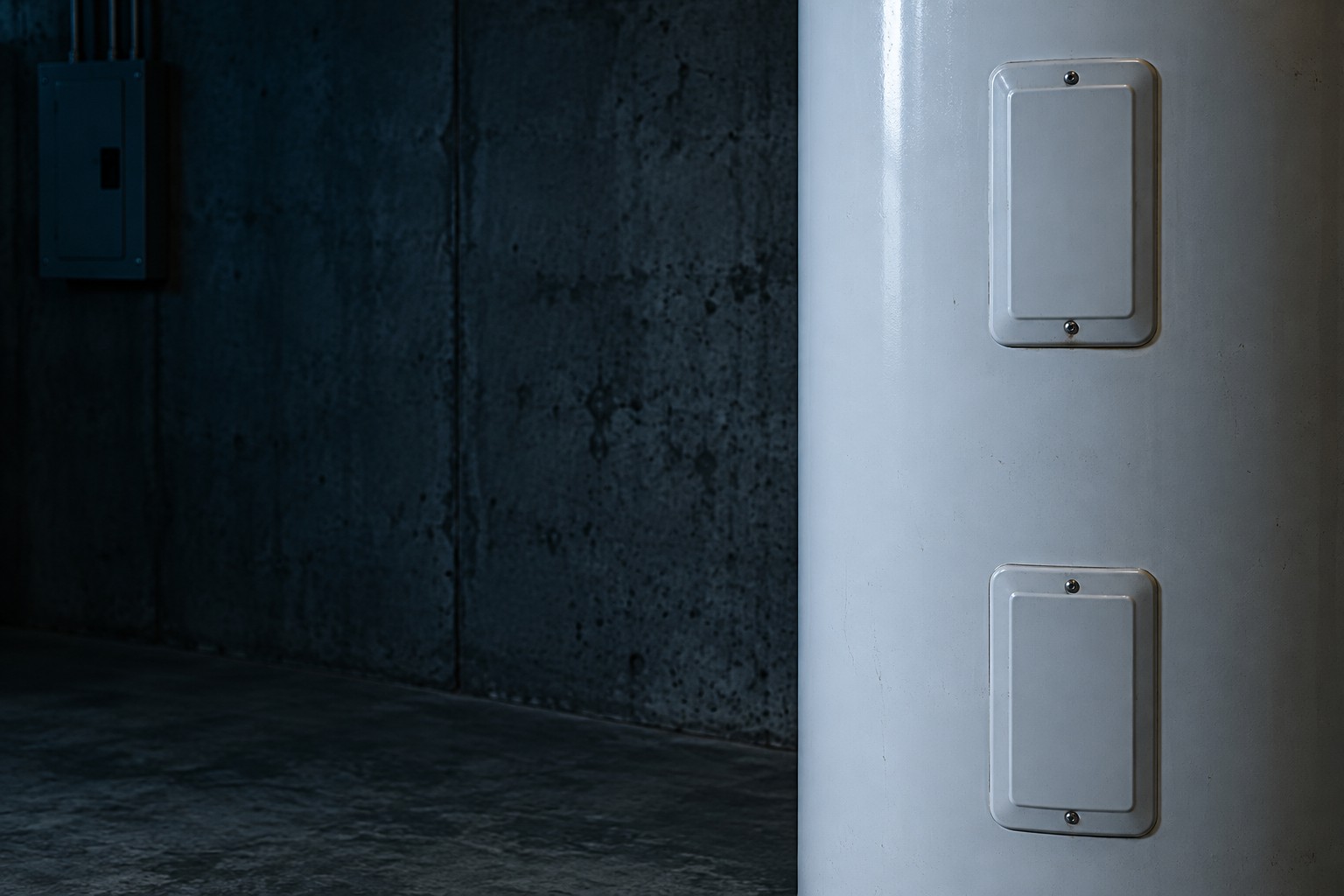
60 °C (140 °F) for residential storage; no more than 49 °C (approximately 120 °F) at ordinary showers and baths. Mixing valves protect delivery; peak controllers manage power. These functions are different.
Storage and delivery are different.
The temperature inside a storage tank is not the same as the temperature delivered at a shower. Keep stored water sufficiently hot, then limit temperature at the point of use to reduce scalding risk. [1, 2]
| Location | Québec reference |
|---|---|
| Storage water heater | A setting intended to maintain stored water at least at 60 °C (140 °F); the usual residential setpoint is 60 °C (140 °F). |
| Ordinary showers and bathtubs | Maximum delivered temperature: 49 °C (approximately 120 °F), according to the requirements applicable to the installation. |
| Showers and baths in private seniors’ residences and care facilities | Maximum delivered temperature: 43 °C (approximately 109 °F), with appropriate devices and specific requirements. |
| Kitchen and bathroom sinks | Do not assume these outlets are limited to 49 °C (120 °F). Check their protection separately. |
Insufficiently hot water can promote Legionella bacteria. Legionnaires’ disease can be associated with inhaling contaminated fine droplets. Water at 60 °C (140 °F) can also cause rapid scalding: hot storage and point-of-use protection are complementary. [1, 7]
What is the recommended maximum tank setting?
For a typical residential tank, Hydro-Québec recommends maintaining 60 °C (140 °F), rather than heating beyond that temperature unnecessarily. This is not a universal technical ceiling: special systems may operate differently according to their design and manufacturer. Do not arbitrarily raise a tank to 65 °C (149 °F) or 70 °C (158 °F) to compensate for a hot-water shortage. [3]
Fahrenheit values are rounded: 49 °C equals 120.2 °F and 43 °C equals 109.4 °F. There is no single minimum temperature that should be imposed at every faucet.
Use the instructions for your model.
Products available in Québec include conventional electric tanks, three-element ECOPEAK units, heat-pump water heaters, gas storage heaters and tankless units. GIANT, for example, publishes separate manuals for these product families. Instructions for one model should not be transferred to another. [4, 12]
| Equipment | What to check |
|---|---|
| Conventional electric storage tank | Thermostats are often behind access panels. Opening a panel can expose electrical components: isolation and verification of absence of voltage are essential. |
| Three-element ECOPEAK | Several thermostats and a particular heating sequence. Follow the exact manual; do not adjust one thermostat at random. |
| Heat-pump or connected heater | Use the manufacturer’s display or designated controls. Check operating mode and compatibility before adding an external load controller. |
| Gas storage tank | Controls are model-specific. Lettered positions are not universal temperature values. Occupants should not adjust combustion or gas pressure. |
| Tankless heater | The delivery setpoint is different from a storage temperature. A storage tank’s 60 °C (140 °F) reference does not automatically apply to a tankless outlet. |
Before changing a setting
Photograph the rating plate and locate the matching Canadian manual. Record the model, serial number and energy supply. Check whether the equipment is rented, covered by a service contract or connected to Hilo: the provider’s conditions may require a service visit. [4, 8]
Understand the procedure before opening anything.
For external controls, use only the functions described in the manual. For an electric tank with thermostats behind panels, use an electrical contractor holding the appropriate RBQ licence if you cannot safely isolate the circuit and verify absence of voltage.
Reference sequence for an electric tank
- Identify the model and read its procedure. Thermostat number and coordination vary.
- Switch off the circuit and prevent accidental re-energizing. A breaker position alone does not establish absence of voltage: a competent person must verify it with suitable equipment.
- Access controls only as instructed. Do not move wiring or bypass the safety high-limit device.
- Have the thermostats adjusted according to the manufacturer, using the residential reference of 60 °C (140 °F). Do not assume one thermostat controls the whole tank.
- Replace guards, insulation and panels before restoring power. The tank must be completely full of water before it is energized.
- Allow the complete heating cycle specified in the manual, then check delivered temperatures and scald protection. Heating a cold tank can take several hours.
The conventional GIANT manual calls for disconnecting power, accessing the selector and replacing insulation and the panel before power is restored. The exact model’s instructions remain essential. [5, 6]
What a measurement establishes
Use a probe thermometer suitable for liquids, never a hand as a test. Measure stabilized water at an outlet while avoiding splashes; record the outlet and conditions. A reading downstream of a mixing valve describes delivered water, not the entire tank. An infrared thermometer aimed at a faucet or pipe does not reliably measure the stored water.
Keep storage hot. Temper the water delivered.
A thermostatic mixing valve blends hot and cold water to limit delivered temperature. Location, certification, piping and intended use all matter. Installation and adjustment should be handled by a plumbing contractor holding the appropriate RBQ licence. [1, 7]
Conceptual flow diagram, not a complete plumbing installation.
At the tank or near the fixture?
In an individual home, a central mixing valve can limit distribution temperature while storage remains at 60 °C (140 °F). Do not assume it replaces the protection required at a shower or bath. A local device acts near the point of use; the plumber must select the appropriate type and verify actual delivery. [7]
In a shared or complex distribution network, private seniors’ residence or care facility, reducing temperature throughout distribution can create lukewarm sections. RBQ specifically rejects a central valve set to 43 °C (approximately 109 °F) as the temperature-control solution for seniors’ residences and care facilities. Protection must be designed for the building, often near the outlets. [1, 2]
Three different devices
- Thermostatic mixing valve: controls the temperature of the blend.
- Pressure-balanced faucet: primarily compensates for pressure fluctuations. Its temperature limit still needs adjustment; it does not regulate temperature in the same way under all conditions.
- Temperature-and-pressure relief valve: protects the tank against excessive conditions. It is not a comfort control and must never be plugged, disabled or replaced by a mixing valve.
A valve’s presence is not proof of effective protection. Scaling, poor adjustment or failure can change performance. Follow the manufacturer’s inspection instructions and investigate significant temperature changes. [1, 5]
Reduce energy or shift demand?
| Option | Purpose |
|---|---|
| Use less hot water | Reduce heating energy through shorter showers, lower-flow fixtures, leak repairs and cold-water laundry when suitable. |
| ECOPEAK technology | Spread demand with three elements and steadier operation. Operating costs are comparable to a conventional tank; this does not promise fewer kWh. |
| Compatible Hilo or Calypso controller | Pause or shift heating during peak events, then restore power according to protections and program logic. |
| Heat-pump water heater | Reduce electricity use through a different heating technology; choose the appropriate installation and operating mode. |
Hilo acts on the power supply
Hilo describes temporarily cutting power during an event and restarting automatically if the sensor detects an excessively low temperature. This does not authorize a permanent tank setting below 60 °C (140 °F). Hilo asks users not to change internal thermostats except to correct a setting below that reference, following the manufacturer’s instructions. [8, 9]
Calypso compatibility must be checked
Sinopé’s Zigbee RM3500ZB and Wi-Fi RM3500WF Calypso controllers switch power, rather than set tank temperature. Their functions, gateways and integrations differ. Check exact Hilo or Éco Sinopé compatibility, load rating and temperature protection. Use an electrical contractor for installation and keep the sensor and safety protections active. [10]
Financial savings depend on the tariff or program, eligibility, shifted consumption and installation cost. Reheating after an event still uses electricity. No savings percentage is guaranteed here. [10, 11]
What to check at home.
The shower is too hot
Have the faucet limit, mixing valve and actual temperatures checked. Lowering tank storage to mask missing or defective scald protection does not address the cause.
Hot water runs out quickly
Record whether one fixture or the entire home is affected, whether it follows several showers and whether it coincides with a peak event. Ask for capacity, elements, thermostats, mixing valves and controls to be checked before raising the setpoint.
You manage a rental property or condominium
Separate tanks in each unit and central hot-water production are different arrangements. Changes to storage, recirculation or mixing must account for the full network and its occupants.
To reduce your bill
- Reduce hot-water volume through leak repairs, shower flow and habits.
- Keep the residential reference setpoint of 60 °C (140 °F).
- Move dishwashing and major hot-water draws outside peak events where practical.
- Evaluate a compatible controller and the associated tariff. Do not improvise a timer or ordinary smart plug on a water-heater circuit.
- At replacement, compare capacity, technology, installed cost and maintenance needs.
Five-point checklist
- Model and Canadian manual identified.
- Storage setpoint checked; no permanent reduction for savings.
- Bath and shower protection checked, with attention to other outlets.
- Mixing device selected for the actual network.
- Compatible peak management, active protections and proper installation.
This guide explains principles for residential installations in Québec. It does not replace the manual, collective-network design or an on-site assessment. Applicable requirements depend on the building and work. Information checked October 29, 2026; reconfirm current offers and compatibility. [1-12]
Sources and references
- RBQ - Cahier explicatif, plomberie, juin 2021 ↗
- Éditeur officiel du Québec - Code de construction, chapitre III, plomberie (températures et protections) ↗
- Hydro-Québec - Conseils sur le chauffage de l’eau ↗
- GIANT - Manuels des appareils vendus au Canada ↗
- GIANT - Chauffe-eau électriques conventionnels, manuel GI-IM017Fr ↗
- GIANT - Manuel ECOPEAK à trois éléments ↗
- Enbridge Gaz Québec - Sécurité et prévention (températures et mitigeurs) ↗
- Hilo - Peut-on ajuster la température du chauffe-eau? ↗
- Hilo - Fonctionnement pendant les événements de pointe ↗
- Sinopé - Contrôleur Calypso : fonctionnement et compatibilité ↗
- Hydro-Québec - Chauffe-eau à technologie ECOPEAK ↗
- GIANT - Voltex AL, chauffe-eau à thermopompe connecté, manuel ↗