
Pyrite: a slab crack alone is not a diagnosis.
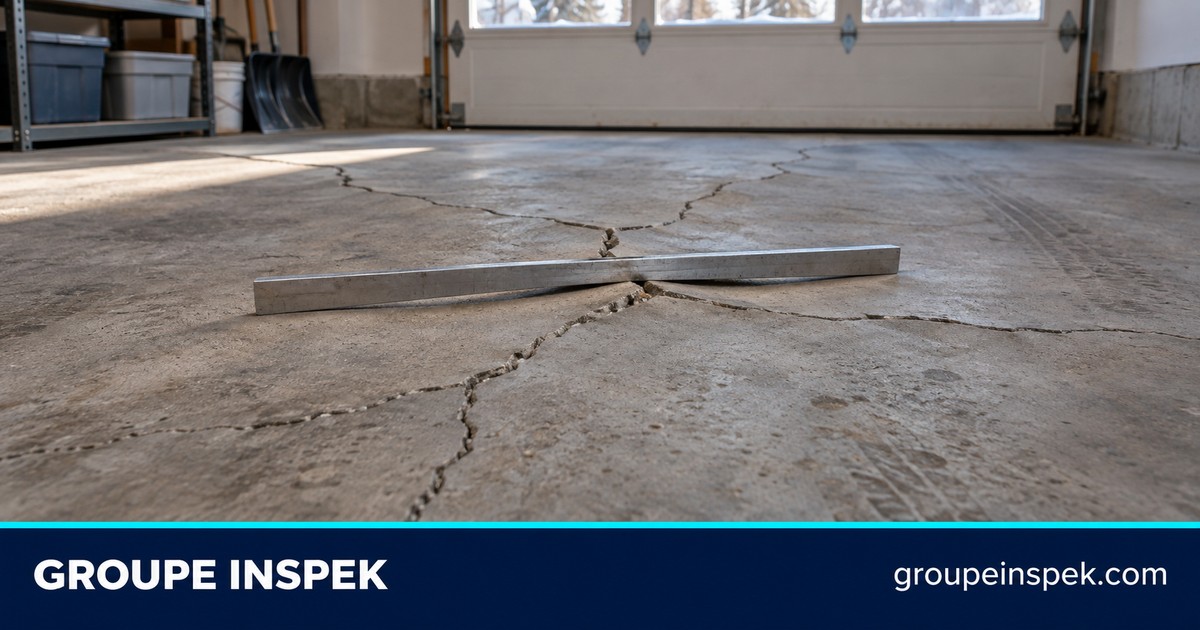
When some fills contain reactive sulphides under favourable conditions, oxidation may cause expansion beneath a slab. Possible damage must be distinguished from shrinkage cracks, settlement and other movement.
PEPI is not a percentage and is not, by itself, a repair verdict. Building age, slab condition, fill thickness, sulphide type and other laboratory findings must be interpreted together.
Which indications may raise concern?
- Cross-shaped or star-shaped cracking and apparent slab heaving.
- Basement partitions or doors that move or distort.
- A crowned garage slab with possible pressure on walls or the threshold.
- Efflorescence and concrete deterioration, which may also have other causes.
None of these indications confirms pyrite. Conversely, reactive fill may exist before substantial damage becomes visible.
What does an investigation generally include?
The CTQ-M200 protocol calls for sampling concrete, fill and native soil along with construction observations. The laboratory evaluates the fill and its potential for swelling. The number and location of test holes should correspond to the areas being assessed.
How should PEPI be read?
The petrographic expansion potential index uses a scale from 0 to 100; it is not a percentage of pyrite. The OACIQ warns against inserting an arbitrary cut-off value into a promise to purchase. The laboratory conclusion and the other observed factors matter more than an isolated number.
Must the slab always be rebuilt?
No. The decision depends on damage, progression, intended use and specialist interpretation. Significant damage may require removal of the slab and problematic fill followed by suitable reconstruction. A result without observable damage may instead lead to monitoring or further assessment.
The inspector’s role
An inspection may document cracking, heaving, distortion and related indications, then recommend testing. It cannot identify the mineral composition of fill. Diagnosis depends on sampling and interpretation by a competent laboratory or specialist.
Sources and references
The following sources frame and support this content. The service agreement and the standard applicable to the assignment remain controlling.